
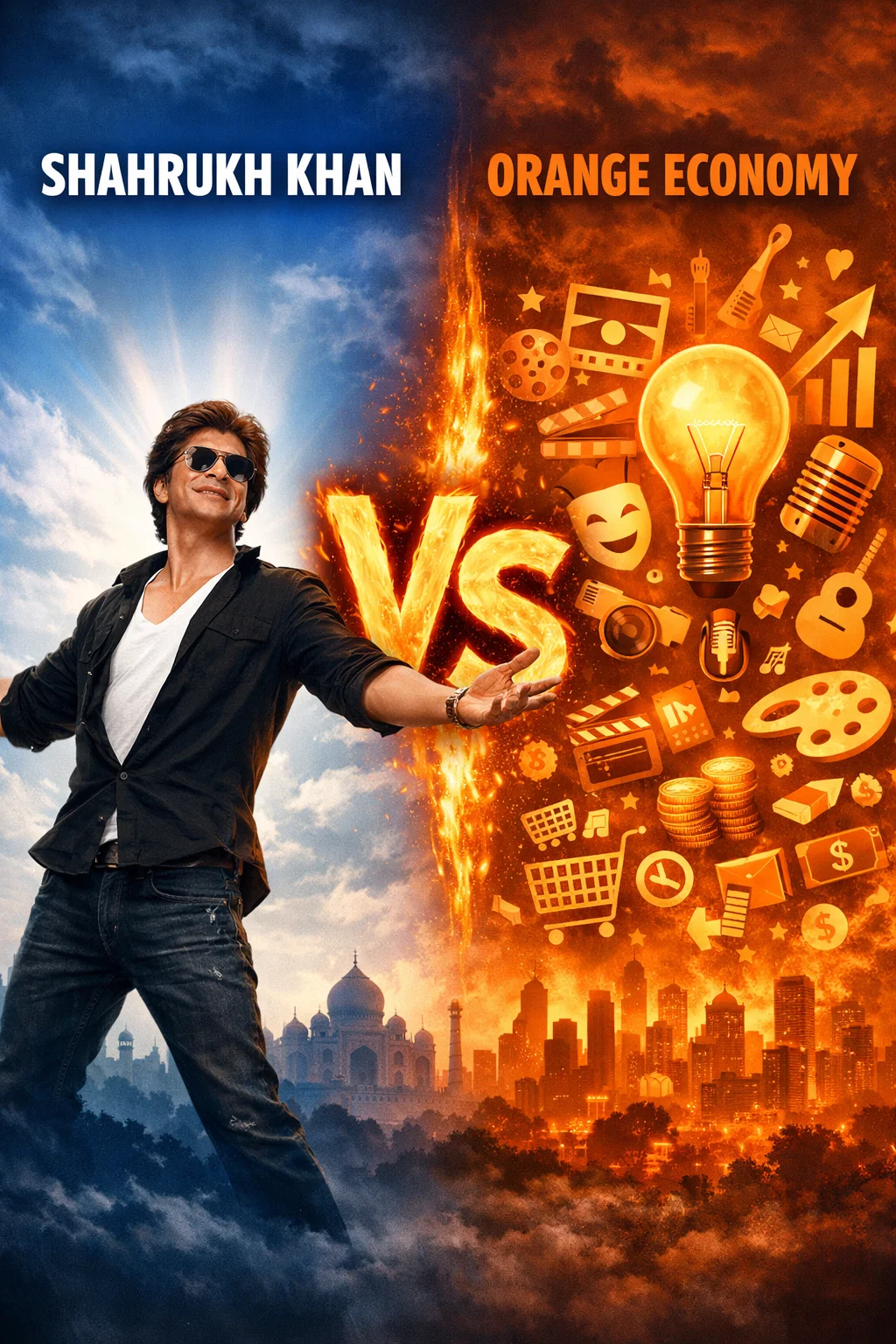
Mr. Shah Rukh Khan might not know this yet, but a quiet storm is building outside the gates of Red Chillies.
Not a scandal. Not a boycott. Something far more fundamental: the very tools and economics of how movies, VFX and animation get made are being rewritten. And for once, it’s not just the big boys at the table.
This is the story of India’s “Orange Economy”, AI video tools, college kids with laptops – and why 2026 could be the year the VFX game gets democratized.
What on earth is this “Orange Economy”?
When we think of the Indian economy, we usually think of agriculture (green), industry (grey), or services (blue). But there’s another layer the world has started talking about: the “Orange Economy”.
The Orange Economy is everything that’s powered by creativity and ideas rather than physical products – content creation, design, music, film, animation, gaming, VFX, comics, cultural IP, and all the businesses built around them.
In the Union Budget 2026, the Government of India quietly did something big: it decided to explicitly back this Orange Economy, with a sharp focus on the AVGC sector – Animation, Visual Effects, Gaming and Comics. The numbers being discussed range from hundreds to thousands of crores earmarked to build infrastructure, training and support systems for creators and studios.
This isn’t just about “supporting art”. It’s a hard-nosed economic bet: India wants to position itself as a global hub for animation, VFX and gaming – the same way we became a hub for IT and back-office services.
Why Red Chillies is suddenly part of this conversation
Now, why does Shah Rukh Khan’s Red Chillies suddenly show up in this narrative?
Because Red Chillies VFX is one of the most prominent VFX studios in India, known not just for Bollywood blockbusters but for work that meets international standards. For years, high-end VFX and animation meant big studios: large teams, expensive software, heavy hardware, and long pipelines.
The implicit assumption in the industry was: “If you want world-class VFX, you have to go to people like them.”
But that assumption is now under attack from two sides at once:
- From the top: the government is pouring money into building a massive talent and infrastructure pipeline in AVGC – labs, training, courses, and incentives.
- From the bottom: new AI tools are making it radically easier – and cheaper – for individuals and small teams to do work that used to require big studios.
Put together, this means Red Chillies and similar studios are about to face a kind of competition they’ve never had before – not just from other studios, but from armies of highly skilled, AI-armed individuals.
The Canva moment for VFX and animation
Think back to what Canva did to graphic design.
There was a time when you needed Photoshop skills, training, and a designer to make a decent poster or social media creative. Today, a college kid can spin out 20 decent designs in an hour on Canva without knowing a single shortcut in Photoshop.
We are now seeing the Canva moment arrive for VFX and animation.
AI video tools like Kling 3.0 (hosted on platforms like Higgsfield) allow you to type out a prompt – “a car chase through the streets of Mumbai at night”, “a warrior walking through a mystical forest”, “a sci-fi robot dancing on the moon” – and within minutes get cinematic, hyper-realistic video clips. These tools are evolving to:
- Handle multiple shots and camera angles in one go
- Maintain consistent characters across scenes
- Add realistic motion, physics, and lighting
- Integrate music and sound design into the workflow
What used to take a full pipeline – concept art, 3D modelling, rigging, animating, rendering – is starting to compress into “describe what you want clearly, iterate with prompts, refine”.
Is it perfect yet? No.
Is it “good enough” for ads, YouTube, music videos, short films, concept pieces, pitch decks, and social media? Increasingly, yes.
And the pricing is aggressive: high-volume generation, steep discounts, and “unlimited” plans that let small teams experiment like crazy without burning a hole in their pocket.
This is why the comparison to Canva isn’t just a metaphor. It’s a signal: VFX and animation are no longer locked up with a few studios. They’re moving into the hands of anyone willing to learn the tools and put in the creative work.
AI film festivals: where the new wave is showing itself
This isn’t just theoretical or “future stuff”. The wave has already started to break on the shores of India.
In the past few months, cities like Goa, Mumbai, and Delhi have seen AI Film Festival formats emerge – events where teams submit short films created largely or significantly using AI tools. Panels discuss AI workflows, juries evaluate storytelling and originality, and winners walk away with prize pools in the range of a few lakhs.
That kind of prize money is not life-changing for a big studio. But for:
- A group of college students
- A lone creator experimenting with AI films at night
- A young team trying to build a portfolio
…a 3–10 lakh win is enough to buy them time, tools, and credibility. It’s stage one of a flywheel: legitimacy → visibility → paying clients → proper business.
More importantly, AI film festivals send a cultural signal: “This is now a real medium. You are allowed to take it seriously.”
From here, it’s not hard to imagine:
- Agencies commissioning AI-heavy short ads on tight budgets
- Musicians releasing AI-visualized music videos
- Brands experimenting with AI-driven explainer films
- OTT platforms running special segments or anthologies for AI-made shorts
And once the money starts flowing, the ecosystem deepens very quickly.
How this mirrors the rise of content creators vs big media
The note you shared makes a very sharp analogy: what independent creators did to big media houses, individual AI creators could do to big VFX studios.
Think of how media consumption has changed:
- Earlier: we waited for TV channels and newspapers to tell us what’s happening.
- Now: many people trust specific YouTubers, podcasters, and Instagram creators more than traditional news channels.
The power shifted because:
- Distribution moved from TV networks to the internet.
- Tools to create and publish content became cheap and accessible.
- Individuals could build direct relationships with audiences.
Something very similar is brewing in VFX and animation:
- Distribution: You no longer need theatrical releases to showcase your work; you have YouTube, OTT, social media, and brand campaigns.
- Tools: High-end VFX-like output is increasingly possible with AI tools on consumer hardware.
- Relationships: A small AI-first studio can work directly with global clients through platforms, LinkedIn, communities, and referrals.
The “big versus small” story is repeating, but in a new domain.
What this means for students, young professionals, and small creators
If you zoom out, the pattern is clear: 2026 onwards is a window where early movers can grab serious advantage.
For a college student or young professional, this new wave means:
- You don’t need to wait to “get a job at a studio” to start doing serious work.
- You can start experimenting today – with stories, aesthetics, formats – and build a strong portfolio.
- You can team up with 2–3 friends (writer, prompt-artist, editor, sound) and operate like a mini-studio from your hostel room or bedroom.
For freelancers and small agencies:
- You can add AI-powered VFX/animation as a service line to your existing offerings (branding, social media, content, production).
- You can become the “go-to” specialist for AI-driven videos in a niche: say, explainer videos for startups, music visualizers, ad concepts, pre-visualisations for films, or pitch films for real estate projects.
- With the government nurturing a pipeline of AVGC talent and the market hungry for content, demand is likely to grow faster than traditional supply alone can fulfil.
In short: the moat has lowered. The gatekeeper is now your skill, taste, consistency, and ability to ship – not whether you have a 200-person studio behind you.
And for the big studios?
Does this mean big studios like Red Chillies are doomed? Not necessarily.
What it does mean is:
- They will need to rethink their cost structures, pipelines, and value proposition.
- They can no longer rely purely on “we have the best hardware and software” as a differentiator.
- Their real advantage will have to come from scale, relationships, large integrated projects, IP, and the ability to orchestrate complex productions at a level that small teams can’t easily match.
The disruption is less “you will die” and more “you will be forced to evolve”.
If they embrace AI, retrain teams, build hybrid pipelines (traditional + AI), and tap into this new creator base (through partnerships and ecosystems), they can become even more powerful. If they ignore it, they risk being undercut on cost, speed, and experimentation.
So what is this all about, really?
Under all the jargon – Orange Economy, AVGC, AI video tools, AI film festivals – this is about a simple shift:
- From: a world where only a handful of big players could afford to do high-end visual storytelling.
- To: a world where anyone with imagination, discipline, and the willingness to learn new tools can play.
It’s about making animation and VFX “as easy as using Canva” – not because the craft disappears, but because the heavy lifting is increasingly handled by machines, leaving more room for pure creativity, storytelling, and taste.