

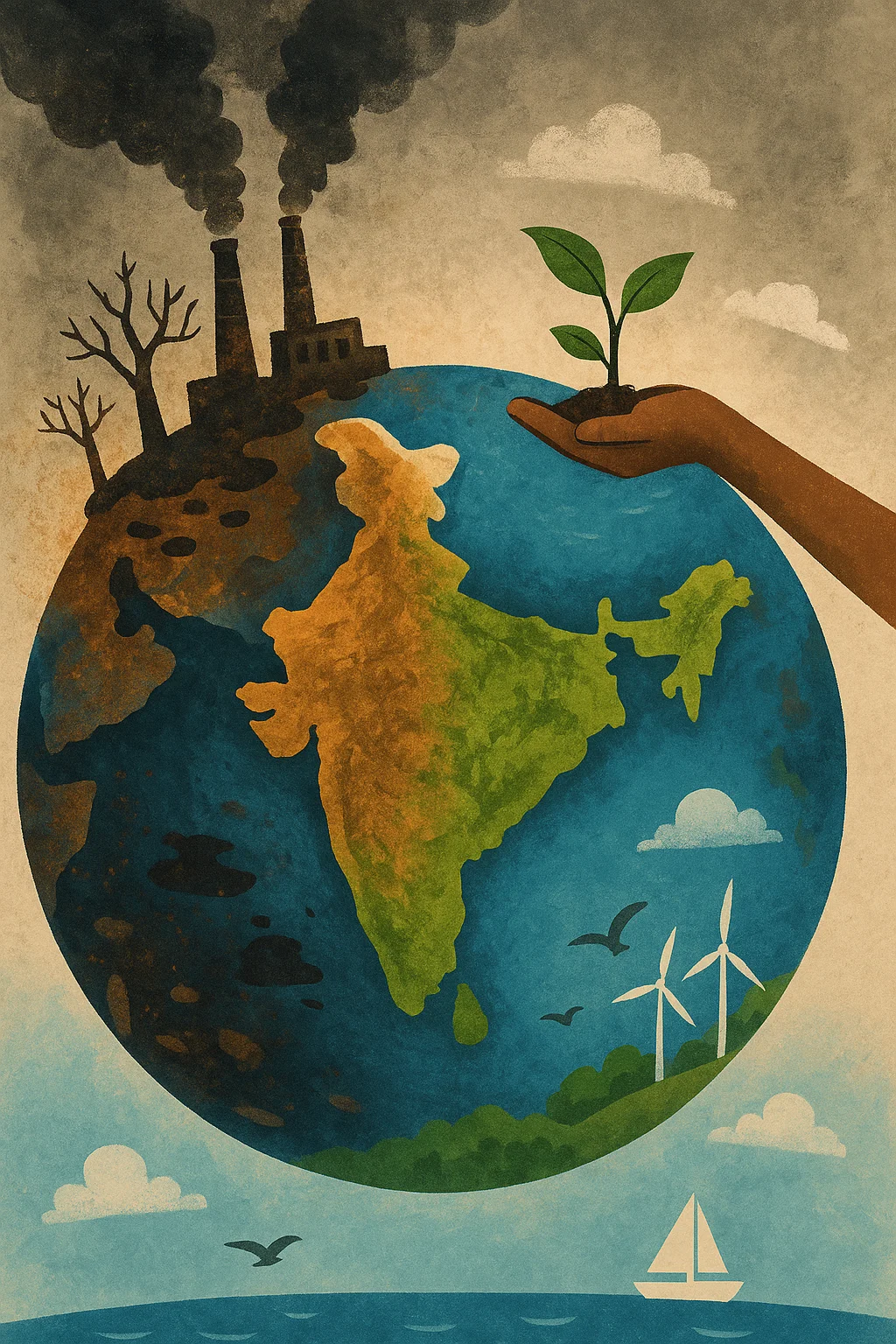
Carbon credits in India are about to stop being a “nice ESG thing” and start becoming a real, rule-driven market—where companies that emit less than their allowed limit can earn tradable certificates, and companies that emit more may need to buy those certificates to stay compliant. India is building this through the Indian Carbon Market (ICM) under the Carbon Credit Trading Scheme (CCTS), and the system is already being operationalised—not just discussed.
The carbon credits wave (and why everyone’s watching 2026)
If you run or advise industrial businesses, you’ll recognise the pattern: when the government sets targets, a whole ecosystem gets created around measuring, reporting, reducing, and proving compliance. That’s what’s happening now with carbon.
India has already notified Greenhouse Gas Emission Intensity (GEI) targets under the CCTS compliance mechanism, and as of January 2026, government communication indicates the compliance mechanism covers 490 obligated entities across multiple high-emission sectors. So when people say “mid‑2026 is when it takes off,” what they’re really pointing to is the moment this shifts from early-stage preparation to real execution—more onboarding, more audits, more trading, and more urgency.
First, what is a carbon credit in this context?
In the Indian compliance market, think less like “a feel-good offset” and more like “a measurable performance certificate.”
- The government sets an emissions-intensity target for large entities in covered sectors.
- If a company beats its target (i.e., performs better than required), it becomes eligible for issuance of Carbon Credit Certificates (CCCs).
- If a company misses its target, it may need to buy CCCs from others and surrender them to cover the gap.
That’s the simple logic: outperform → earn certificates → sell; underperform → buy certificates → comply.
So where does the “business opportunity” come from?
Most viral posts focus on “trading” because it sounds sexy. But the bigger, more reliable opportunity is usually the services layer that makes credits possible and defensible.
1) Compliance advisory for large factories
A lot of obligated entities don’t have clean internal systems for carbon data capture and audit trails. Helping them set up processes for emissions data, reporting, and documentation becomes a high-value service—because if they can’t prove it, they can’t benefit from it.
2) MRV: Measurement, Reporting, Verification support
Government communication describes the building of a “robust MRV framework” and procedures for accreditation of carbon verification agencies. That means there will be demand for consultants who can make companies “MRV-ready” (systems, SOPs, evidence files, dashboards), and for verification/audit capacity as the market scales.
3) Offset/project development and aggregation
The scheme also includes an offset mechanism, and the government has stated that even non-obligated entities (including renewable energy producers) may voluntarily register mitigation activities and seek issuance of carbon credit certificates. That’s where developers/aggregators come in: bundling projects, preparing documentation, and helping projects get registered and monitored.
4) Trading and market facilitation
Yes, there will be trading—but don’t assume the “5–15% commission” is guaranteed. In regulated markets, pricing, spreads, and fees evolve with liquidity and exchange rules. The more realistic “trader” opportunity is for those who can package deals end-to-end: documentation, counterparty comfort, compliance timelines, and transaction execution—not just matching buyer and seller.

The plumbing India is putting in place (this is important)
For a market to work, you need more than rules—you need infrastructure.
Government communication outlines that:
- Carbon credit certificates are intended to be traded through power exchanges.
- The Grid Controller of India is to function as the registry for the Indian Carbon Market.
- The Bureau of Energy Efficiency (BEE) serves as the administrator.
- CERC provides regulatory support for trading activities under the ICM.
This matters because it tells you it’s not just a “private marketplace idea.” It’s being set up as a formal market with institutions, oversight, and a registry backbone.
A quick reality check on the viral numbers
Two common exaggerations float around:
- “It’s only 400 entities”
Government communication indicates 490 obligated entities are already covered under the compliance mechanism as of January 2026. - “Credits will be ₹400–₹2,000/ton and traders will make 5–15%”
Carbon prices vary wildly depending on market design, liquidity, quality, and whether the credit is compliance-grade or voluntary. The Indian market’s realised price bands will settle only after trading deepens. Treat any fixed price/commission range as indicative marketing, not a guaranteed business model.
Where CRI (Carbon Registry India) fits
A lot of people mention “Carbon Registry India” as a starting point. CRI presents itself as a voluntary carbon registry and a platform for tracking/listing/transferring carbon offset credits. That’s useful context, but don’t confuse voluntary registries with India’s compliance market under CCTS—your service design will differ depending on which ecosystem you’re serving.
The bottom line: what this is really about
Carbon credits in India are becoming a “new compliance + marketplace layer” over heavy industry. The money won’t only be made by people who “trade credits”; it will be made by those who help businesses measure correctly, reduce intelligently, document properly, verify confidently, and transact smoothly.